



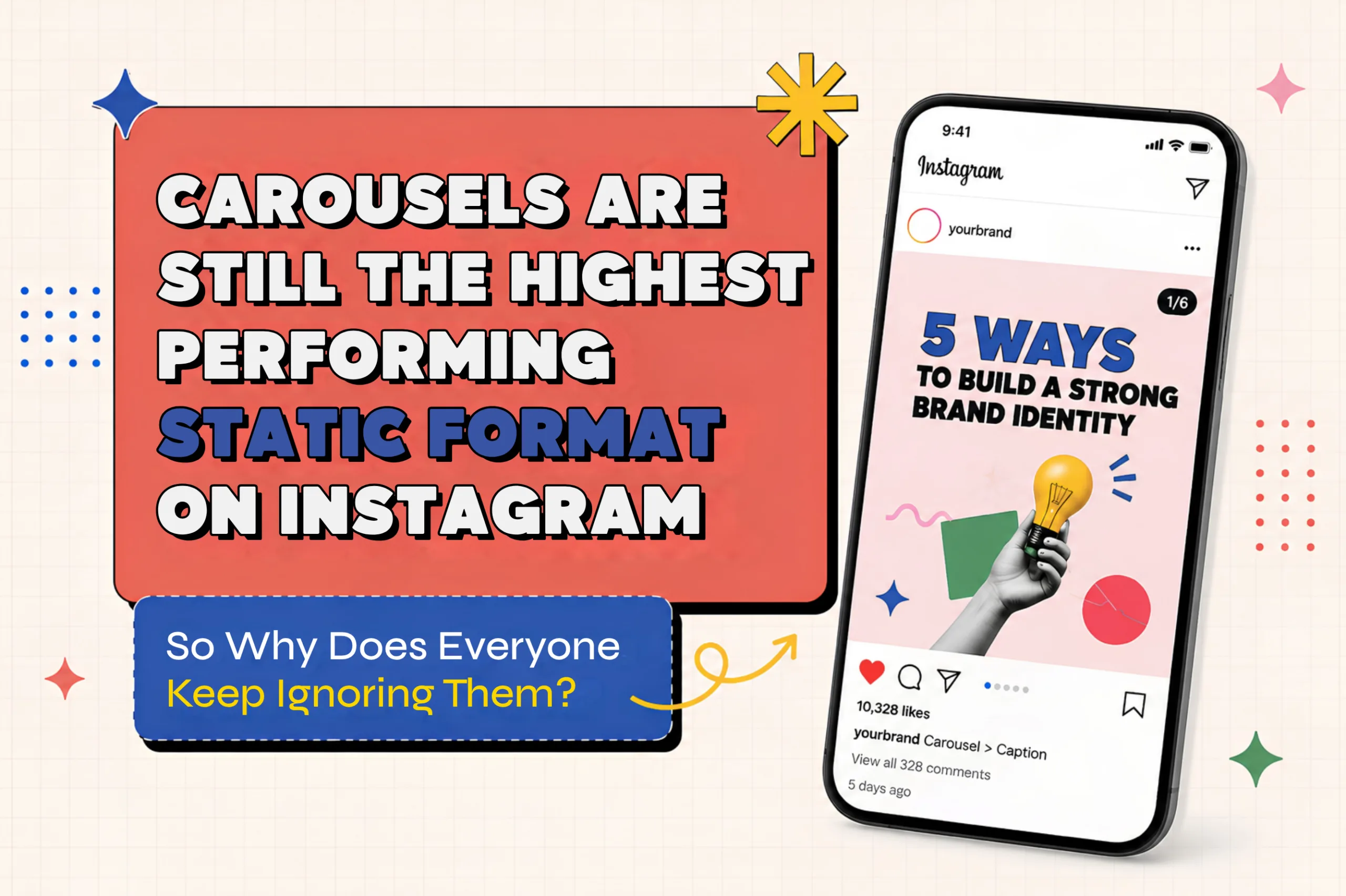
Every few months, someone declares a format dead. Carousels were supposed to be next. Reels took over the feed, short-form video dominated the conversation, and carousels quietly got deprioritised by teams chasing what felt new. The data never agreed. Carousels consistently outperform single-image posts on reach, saves, and shares. Instagram’s own algorithm resurfaces them to users who didn’t engage the first time. No other static format gets a second chance like that.
The reason carousels keep working is not a platform quirk. It’s a behaviour one. A well-built carousel gives a person a reason to keep swiping. Each slide either answers a question, raises the next one, or delivers a piece of value that makes the swipe feel worth it. That interaction time signals to the algorithm that the content held attention, and attention is the currency every platform is optimising for right now. A single image can stop the scroll. A carousel can hold it for ten seconds longer, and that difference compounds across thousands of impressions.
Where most brands get it wrong is treating carousels as a design exercise rather than a content structure decision. The first slide is an ad for the rest of the carousel. If it doesn’t make someone want to swipe, the format doesn’t matter. The slides in between need to move, not repeat. Each one should add something: a number, a counterintuitive point, an example, a contrast. The last slide needs a reason to exist beyond a logo and a “follow us.” The brands whose carousels get saved and reshared are the ones that treat each slide as its own piece of value, not a continuation of the same sentence.
At The Social Lions, a design marketing agency in Mumbai, carousels are a core part of every Instagram content strategy we build, not because they are fashionable but because they reliably drive the metrics that matter: saves, shares, profile visits, and the kind of sustained reach that paid spend alone does not buy. The format is not broken. The briefs are. When the thinking behind a carousel is as strong as the design, the results follow. Most teams skip the thinking. That is the actual reason carousels get ignored, and it is the easiest problem to fix.